
Resources


















Frequently Asked Questions
Cure Time
What is the setting/curing time of Polecrete Stabilizer products until they are 100% cured?
15 minutes at 70°F (20°C).
Colder temperatures can lengthen curing times.
Disposal
What is the disposal procedure for cured Polecrete Stabilizer products when they need to be removed? Are they landfill acceptable?
Yes. Cured urethane foam is legally acceptable for disposal in landfills.
What is the disposal procedure for the A and B component containers? Are they readily acceptable in landfills?
Yes. Empty plastic containers can be recycled or disposed of in landfills.
Environmental
What environmental standards do Polecrete Stabilizer products meet?
All Polecrete Stabilizer products are classified as non-hazardous by the United States Environmental Protection Agency (EPA) and Department of Transportation (DOT).
They have also been confirmed as having zero Ozone Depletion Potential (ODP) and Global Warming Potential (GWP).
Are any environmental permits required to use Polecrete Stabilizer products?
No.
Can Polecrete Stabilizer products be safely used in bodies of water like sloughs or wetlands, or contained within a culvert, for example?
While most closed-cell urethanes typically float in water, Polecrete Stabilizer foam products have been used successfully in marshy environments.
Once cured, the foam typically performs better in these environments compared to other tamping or holding materials.
Is there any danger to wildlife, plants, or water species before or after Polecrete Stabilizer products are cured?
In liquid form, Polecrete Stabilizer foam products should not be consumed.
After the foam has cured, it is inert, non-digestible, and does not break down.
Is there any restriction on using Polecrete Stabilizer products in pastureland or other animal-sensitive areas?
No.
Do Polecrete Stabilizer products have any properties that may attract animals, such as sodium?
No.
Are there any chemical byproducts or vapors produced when Polecrete Stabilizer products are mixed and installed?
Polecrete Stabilizer products release carbon dioxide (CO2) during the mixing process.
Are Polecrete Stabilizer products flammable? How will they stand up to grassfires or lightning strikes? Do they need to be grounded?
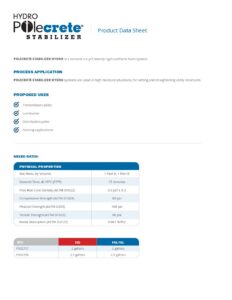
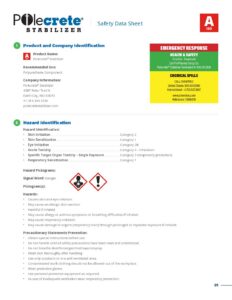
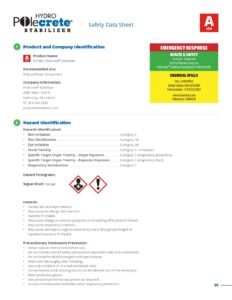
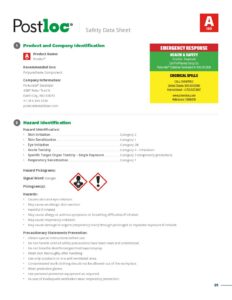
Please refer to the individual Technical Data Sheets (TDS) and Safety Data Sheets (SDS) for each Polecrete Stabilizer product.
Outdoor Temperatures
Can Polecrete Stabilizer products be used in outside temperatures below 0°F?
Yes. However, for best results, kits should be kept at 70°F (20°C) prior to use. In addition, holes should be augured at the same time the product will be used.
Will cured Polecrete Stabilizer products shrink when the temperature drops, affecting bonds to the pole/pad and surrounding soil, potentially opening gaps or cracks for moisture to seep in?
No.
Does humidity affect curing times?
No.
Safety & Handling
What is the recommended PPE to be worn while using Polecrete Stabilizer products?
Users should wear eyewear that conforms to the ANSI Z87.1 D3 standard, as well as chemical-resistant gloves.
Face masks or respirators are not required but are recommended.
Are there specific procedures to follow when handling Polecrete Stabilizer products?
Yes. Instructions are provided with each kit.
We also have a number of how-to videos available in the Resource Library on our website.
Polecrete Stabilizer representatives can also provide an in-person demonstration to your crew at no additional charge.
Are there any safety requirements needed to remove Polecrete Stabilizer products?
Do not burn the cured foam.
Are there any health risks if Polecrete Stabilizer products are transported inside the cab of a vehicle, as opposed to a trunk or truck bed?
No.
Shelf Life & Storage
What are the safe storage requirements and acceptable storage temperature ranges for Polecrete Stabilizer products?
Closed and unopened containers of Polecrete® and Postloc® components should be stored out of direct sunlight at temperatures between 50°F and 95°F (10°C and 35°C).
RSP™ and Padcrete™ can be stored at temperatures up to 105°F (40°C).
Must Polecrete Stabilizer products be kept in a warm environment before use in the field, such as in the cab of a truck?
For best results, we recommend that all products are kept within the recommended storage temperature range prior to use.
What is the normal shelf life of Polecrete Stabilizer products?
Shelf life varies between products.
RSP™ and Padcrete™ can be safely stored for up to twelve (12) months before use, while unopened Postloc® and Polecrete® components have a shelf life of twenty-four (24) months.
Postloc® and Polecrete® components remain usable as long as they are stored under recommended conditions and proper care is taken to agitate the ISO (A) and Polyol (B) components before mixing if the product has been stored for an extended period of time.
All Polecrete Stabilizer products should be kept tightly sealed, as they are moisture-sensitive.
What is the life expectancy of Polecrete Stabilizer products?
We do not have a definitive answer, but we expect the lifespan to be indefinite.
Polecrete Stabilizer has been in existence since 1988, and foam used in installations from that time is still performing today.
Technical
Can previously cured foundation foam be left in place should a pole failure occur?
Yes. However, when a pole is removed from the ground, the urethane will typically come out with it. This is a testament to the holding strength of Polecrete Stabilizer foam products.
What are the chemical properties of Polecrete Stabilizer products, and have there been any studies on the impacts they have on the longevity of wooden poles?
Rigid, properly mixed urethane foam is completely inert.
Liquid urethane seals the pores of a wooden pole, which helps preserve the pole and prevents wood treatments and preservatives from leaching into the surrounding soil.
What are the loading limits for a typical wooden pole installation?
The loading limit is 80 pounds per square inch (PSI).
Will the foam permanently deform once exposed to sustained loading?
Yes, if loading exceeds the 80 PSI limit.
Is there a maximum pole setting depth? What is the recommended depth of excavation to install Polecrete Stabilizer products?
Standard electric utility installation guidelines should be followed.
A common guideline is:
Depth setting = 10% of pole length + 2 feet
Is there a recommended equation between a utility pole’s class/length and the hole’s size/depth?
Yes. All standard electric utility installation guidelines should be followed.
If the top 2 feet of the hole is backfilled with natural soil, should the pole be buried deeper?
No. Standard electric utility installation guidelines should be followed.
After expansion and curing, Polecrete Stabilizer products occupy the excavation space, reducing or eliminating the amount of soil required for backfill.
Will Polecrete Stabilizer products shrink over time?
No.
If the pole is damaged (e.g., from a lightning strike), how do we remove the pole and clean the foam from the foundation?
Place an auger next to the pole and auger down greater than halfway of the original buried length. Then pull the pole into the augured slot.
New utility poles will shrink. What impact does this have on Polecrete Stabilizer performance?
None.
Are there any UV inhibitors in Polecrete Stabilizer products?
No.
Do the bonding properties of Polecrete Stabilizer products change depending on the material type (e.g., composite, wood, concrete, or steel)?
No. Polecrete Stabilizer products maintain the same bonding properties regardless of the material used.
Do Polecrete Stabilizer products have any impact on underground wires (primary, grounding, etc.)?
No.
If the bottom of the utility pole may remain under water after installation, are there additional installation recommendations?
Yes. Use crushed limestone to help dissipate water, or fill the excavation with limestone up to the water level before installing Polecrete or another Polecrete Stabilizer product.
A new wooden pole will likely experience shrinkage after installation. Will the foam trap water between the foam and pole?
No. Polecrete Stabilizer foam forms a permanent bond directly to the pole, which helps keep water out and typically prevents shrinkage-related gaps.
After years of service under wind and conductor loading, will gaps appear between the pole and foam? If so, can water become trapped and accelerate decay?
No. The foam forms a permanent bond directly to the pole, helping keep water out.
Does the condition of the soil or pole affect the foam’s ability to firmly encase the pole?
No. The condition of the soil or pole does not affect the bonding performance of the foam.
Does standard Polecrete enhance or detract from the grounding characteristics of a wood pole with typical RUS pole grounds?
If the pole is properly grounded, the foam used to set the pole has little to no effect on grounding performance.
The pole should either have a pole ground butt plate installed or wound copper nailed to the bottom of the pole. The ground wire should then be attached and routed up the pole according to RUS construction methods.
If the butt of the pole remains in direct contact with the soil, the surrounding foam does not interfere with the electrical path to ground.
A preferred grounding method for poles set in foam is to drive a ground rod outside the circumference of the foam plug and attach the pole ground wire to that rod.